
Items
Tag
Medicine
-
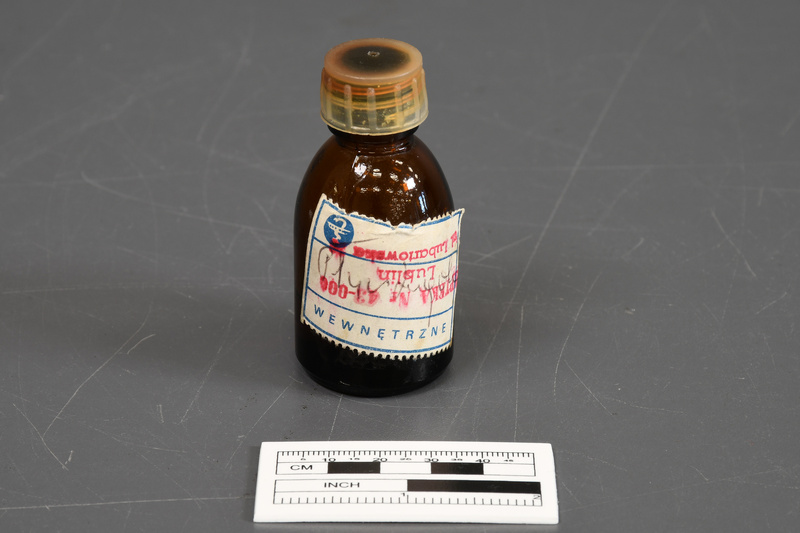 Glass bottle containing iodineThings speak. The circulation of knowledge may pertain to artifacts as well as local, everyday experience that reveals global consequences. A bottle of Lugol’s iodine distributed as public medication during the nuclear fallout in Poland from the Chernobyl Power Plant is one such example. The commonplace qualities of a bottle of iodine are generally unremarkable. This bottle, however, still contains the iodine that was intended as public medication against thyroid cancer during the nuclear fallout from Chernobyl. When the bottle was given to me in 1988, it came with a story. “Without things, we would stop talking. We would become as mute as things are alleged to be. If things are “speechless”, perhaps it is because they are drowned out by all the talk about them. … Talkative things instantiate novel, previously unthinkable combinations. Their thingness lends vivacity and reality to new constellations of experience that break the old molds" (Lorraine Daston, Things That Talk, 2004, pgs. 9, 24). On May 2, 1986, my partner Barbara Lounder and I arrived in Amsterdam. It was the weekend of the Queen's birthday celebration and one week after the Chernobyl nuclear disaster. During May we traveled to Frankfurt, West Berlin and the Rühr district in Germany. In September 1988, I traveled to Lublin, Poland to participate in an exhibition of Canadian artists. My partner Barbara and I had created an artwork that was a response to the time we spent in West Berlin during the Chernobyl disaster. I had a discussion with Malgorzata Sady, one of the Polish curators about the effects of the disaster in Poland. Malgorzata described the anger and fear surrounding the nuclear crisis and showed me a small bottle of iodine that had been distributed by the Polish government as a public health measure. The Lugol’s iodine would avert the thyroid from absorbing the radioactive iodine-131 released by the explosion, potentially reducing the risk of cancer. She highlighted the fact that, in addition to misinformation disseminated by State media, the medication had been distributed too late to be effective. When I asked if she had taken the medicine, she replied, “why bother”. These were the waning days of the Cold War in Poland. At the end of our discussion Malgorzata offered me her bottle of iodine. It was a strange gift from an inconceivable moment in history. In the Fall of 2010, I was invited to be an artist in residence at the Canada Science and Technology Museum in Ottawa. During the residency, I had a conversation with Anna Adamek (Director of the Curatorial Division) regarding her plans for the exhibition “Energy: Power to Choose” that would open in 2011. In response to her plans for the section on nuclear energy and Chernobyl, I mentioned that I had an unusual artifact, the bottle of Lugol’s iodine distributed in Poland during the nuclear fallout. Based on that conversation, the bottle of iodine and several photographs that I made of protests in West Berlin were loaned to the museum for the exhibition. When the exhibition was over in 2014, I re-gifted the bottle of iodine to the museum collection. Currently, it is the only artifact that appears when you search “Chernobyl” in the collection’s data base at CSTM. My anomalous journey with this artifact continues to reveal my place in the world through everyday things, hyper-objects, and the abundant threats to our atmosphere that endanger the rights of human and non-human entities to breath and exist.
 -
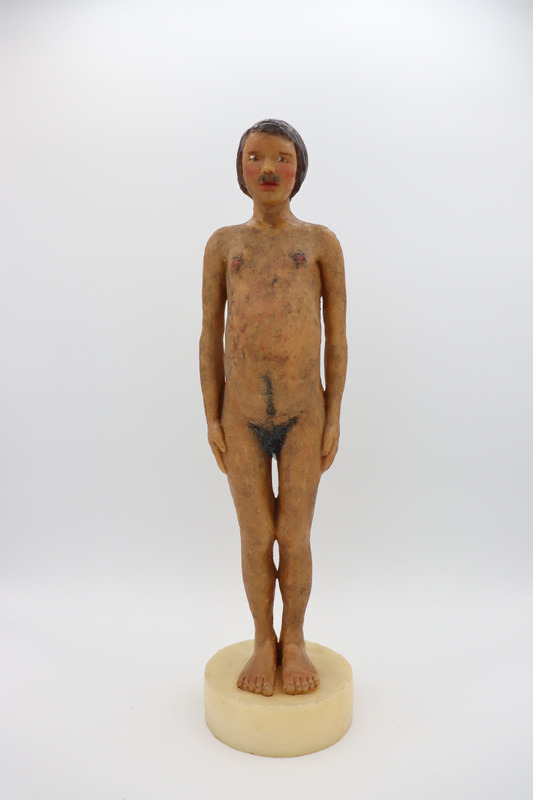 Intersex SomatotypeThis figurine was used during the Second World War to help students without clinical experience ‘recognize’, diagnose, and treat the supposedly pathological traits of intersex peoples’ bodies. As a teaching aid and visual representation, this somatotype demonstrates medical and scientific institutions’ role in solidifying oppressive biases across generations of practitioners. The project that created these somatotypes was inspired by similar models made at Johns Hopkins in the United States, showing how a transnational network of medical expertise interacted with the local practices solidifying the pathologization of intersex people among Canadians. In a 1999 interview, Marjorie Winslow (the artist) recalled that Dr. Robertson encouraged her to exaggerate the 'abnormal' qualities while sculpting the somatotypes. In this case, Winslow used actual human hair to simulate the body hair, pubic hair and moustache that physicians viewed as indicative of the supposed ‘pathology’.
 -
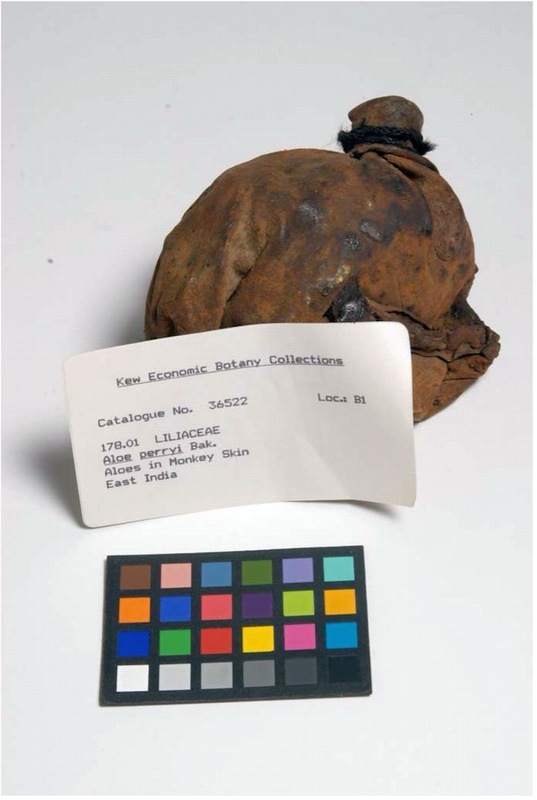 Packaged aloes from Socotra and the CaribbeanThese two items from the Kew Economic Botany Collection show the ways in which aloes were packaged for international trade. Comparing the two distinct methods used to collect, prepare, and transport these specimens demonstrates how the international drugs trade was shaped by African and Native American technologies. Medicinal “aloes” are made from the leaf gel of several different species of the plant. The drug is a black colour and looks rather like the resin of a tree. The first image (Cat. no. 36522) shows Aloe perryi from Socotra, a small island off the coast of Yemen. These aloes were considered the best for medicinal use from at least the 1st century until the 19th century. The second image (Cat. No 36520) shows aloes from the Caribbean. These aloes come from the plant now known as Aloe vera. Both these types of aloe circulated internationally, but their packaging reflects the specific technologies and environments of the places where they were produced. In Socotra, the method of making aloes involved draining the leaf sap into a monkey skin. The sap was left to harden in the sun and then packaged in the same skin for export. Although these aloes come from Socotra, they were sold to traders from western India and marketed internationally from there. This explains the reference to the “East Indies” on the label. In the Caribbean between the 17th and 19th centuries, aloes were exported in gourds, and as such were often known as “gourd aloes”. In both Africa and the Americas, the gourd is used as a container also known as a calabash. In Mexico, it was used to contain pulque, the fermented juice of the agave plant. It was the confusion between agave (also called Aloe americana) and aloe that originally gave rise to the name Aloe vera.
 -
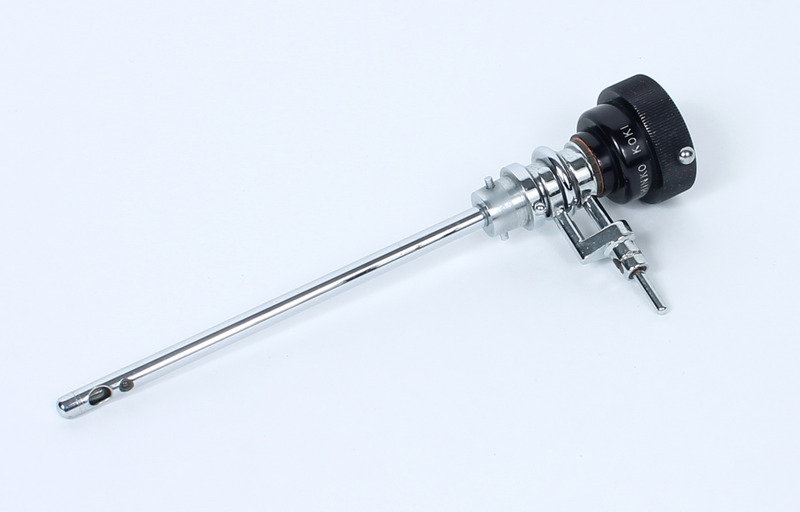 Watanabe "Type No. 21" Side View ArthroscopeThe arthroscope is a surgical instrument that permits the optical inspection of the knee. It was first developed in Japan in the 1950s by a group led by Dr. Masaki Watanabe at Tokyo Teishin Hospital, an institution dedicated to the care of Japanese postal workers and their relatives. It has been suggested that the diagnosis and treatment of knee arthritis received particular attention in Japan due to the cultural importance of the seiza kneeling posture. This particular instrument was among the first practical arthroscopes in commercial production. During its rapid adoption over the 1960s and 1970s, the arthroscope evolved from a diagnostic instrument into the central component of an increasingly effective system for keyhole surgery that drastically improved outcomes and decrease healing time for knee joint surgery. Japan in this period was known for the quality of its optical equipment, especially cameras. This instrument can be fitted to a 1/2 frame 35mm Olympus Pen film Camera. An Atlas of Arthroscopy, first published by Watanabe and collaborators in 1959, helped to spread the technique through excellent colour photos taken using the device. However, Watanabe’s contribution was initially underplayed by the international orthopedic community. Robert W. Jackson, who interned with Dr. Watanabe in Japan in 1964–65, is often credited as having introduced the instrument into the orthopaedic practice, in part through trials done at Toronto General Hospital in 1966. This artifact is one of several from his collection. As the popularity of arthroscopy grew, various international manufactures of surgical instruments, especially those already manufacturing endoscopes, took over the market. The manufacture of precision optical instruments for surgery is now largely based in Germany.