
Items
Tag
Sculpture
-
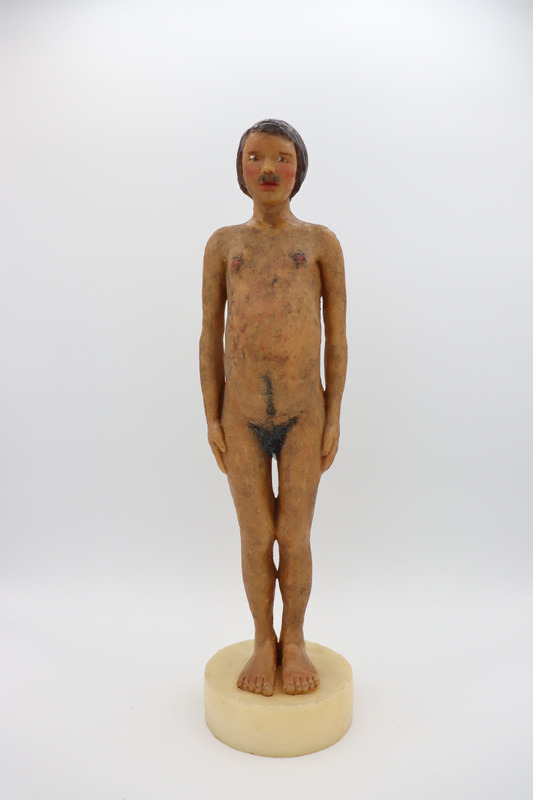 Intersex SomatotypeThis figurine was used during the Second World War to help students without clinical experience ‘recognize’, diagnose, and treat the supposedly pathological traits of intersex peoples’ bodies. As a teaching aid and visual representation, this somatotype demonstrates medical and scientific institutions’ role in solidifying oppressive biases across generations of practitioners. The project that created these somatotypes was inspired by similar models made at Johns Hopkins in the United States, showing how a transnational network of medical expertise interacted with the local practices solidifying the pathologization of intersex people among Canadians. In a 1999 interview, Marjorie Winslow (the artist) recalled that Dr. Robertson encouraged her to exaggerate the 'abnormal' qualities while sculpting the somatotypes. In this case, Winslow used actual human hair to simulate the body hair, pubic hair and moustache that physicians viewed as indicative of the supposed ‘pathology’.
 -
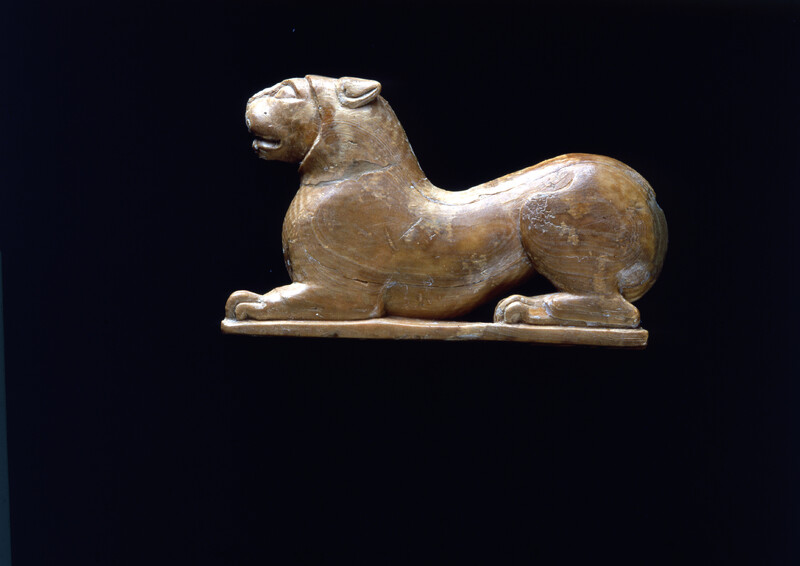 Tessera HospitalisThis object is an ivory lion Tessera, from the sanctuary under Sant’Omobono in Rome. It dates in the range from 7th to 6th centuries BC and has a caption inscribed in Etruscan, the name: Araz Silqetenas Spurianas. The other half of this lion would have been inscribed with whoever Araz had made this pact of friendship with, likely someone from another city or another land, even overseas as far as north Africa or the other reaches of the Mediterranean and beyond. This object is testament of a link between this Etruscan-speaking guest-friend and another. These objects would have formed part of a wider system of private contracts and hospitality on which the Mediterranean network was based. The remains of banqueting and commensality that would have been crucial to maintaining these ties are found in the elite burials of both men and women, and scenes of such activities – banqueting, games, and processions – proliferate on tomb paintings and are a favourite subject of artists, depicted on vessels of all kinds, and in epics – not least those of Homer. They all attest to the circulation of people, objects, both as commodities and as containers of cultures, stories and knowledge. Hospitality allowed for the opening up of networks and importantly for bringing those who are unknown into the realm of the familiar, thus creating intersections of knowledge-exchange. This was materialised in objects such as this tessera hospitalis – a record of reciprocity – that acted as a binding contract extending over geographic distances and generations.
 -
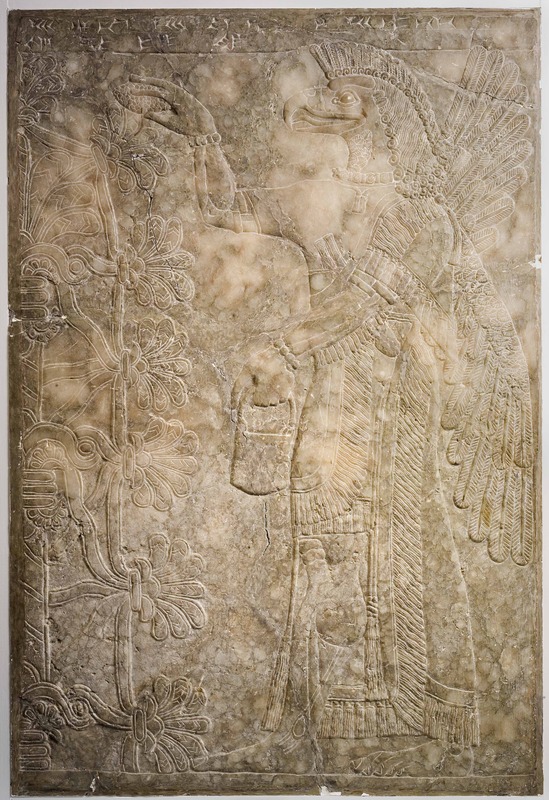 Apkallu with eagle head from the Palace of Ashurnasirpal IIThis sculpture is of an ancient Assyrian mythological figure known as an Apkallu. Apkallu often exhibit characteristics from different groups of animals mixed together; this one has an eagle’s head and wings with the body of a human. It was extracted from the Palace of Ashurnasirpal II near Mosul and brought to Amherst College in Western Massachusetts in the mid-19th century during a period of financial, ecological, and political change. Upon its arrival at Amherst it was placed adjacent to the college’s most famous collection: the world’s first cabinet of fossil footprints. Local naturalists believed that the footprints were left by Jurassic creatures that also mixed characteristics from different living groups, combining anatomical parts from birds, lizards, frogs, and marsupials. Juxtaposing the Assyrian sculptures and the fossil footprints, later known to be made by dinosaurs, helped denizens of the area situate themselves within both human and natural history. The Apkallu was interpreted by 19th century faculty as an attempt by ancient Assyrians to symbolize the power of the Creator by combining the swiftest, strongest, and wisest animals in creation. The Jurassic footprints, meanwhile, were seen as evidence that God had created actual animals with equally fantastical adaptations. Yet, the greatest adaptations, for New Englanders, were not physical but mental, i.e. the capacity to think, act, and behave differently. By showing that they could understand a wide range of phenomena, from Assyrian myths to Jurassic creatures, they were displaying their ability to change their frame-of-mind; to show that as the world changed, they could as well. Curators, artists, and historians are now searching for ways to give these sculptures new functions and meanings. Centuries of looting and military operations have, meanwhile, destroyed many of the remaining sculptures in the original Assyrian Palaces. For the artist Michael Rakowitz, the loss of these historical objects nor their interpretation within museums can be disentangled from the loss of contemporary lives and livelihoods due to war. In response, Rakowitz has reconstructed the destroyed sculptures using intricately plastered wrappers from Middle Eastern food stuffs found in American grocery stores. By reconstructing the sculptures using mediums that families from the Middle East would have encountered when reuniting in America, these “ghosts” or “specters,” as Rakowitz calls them, remind us both of loss but also the potential for healing, restitution, and resurrection.