
Apkallu with eagle head from the Palace of Ashurnasirpal II
- Title
- Apkallu with eagle head from the Palace of Ashurnasirpal II
- Date Created
- 883-859 BCE
- Creator
- Unknown Person, Assyrian
- Identifier
- AC S.1855.5
- Original Location
- Asia; Iraq; Assyria
- Current Location
- Mead Art Museum, Amherst College
- Description
-
This sculpture is of an ancient Assyrian mythological figure known as an Apkallu. Apkallu often exhibit characteristics from different groups of animals mixed together; this one has an eagle’s head and wings with the body of a human. It was extracted from the Palace of Ashurnasirpal II near Mosul and brought to Amherst College in Western Massachusetts in the mid-19th century during a period of financial, ecological, and political change. Upon its arrival at Amherst it was placed adjacent to the college’s most famous collection: the world’s first cabinet of fossil footprints.
Local naturalists believed that the footprints were left by Jurassic creatures that also mixed characteristics from different living groups, combining anatomical parts from birds, lizards, frogs, and marsupials. Juxtaposing the Assyrian sculptures and the fossil footprints, later known to be made by dinosaurs, helped denizens of the area situate themselves within both human and natural history. The Apkallu was interpreted by 19th century faculty as an attempt by ancient Assyrians to symbolize the power of the Creator by combining the swiftest, strongest, and wisest animals in creation. The Jurassic footprints, meanwhile, were seen as evidence that God had created actual animals with equally fantastical adaptations.
Yet, the greatest adaptations, for New Englanders, were not physical but mental, i.e. the capacity to think, act, and behave differently. By showing that they could understand a wide range of phenomena, from Assyrian myths to Jurassic creatures, they were displaying their ability to change their frame-of-mind; to show that as the world changed, they could as well.
Curators, artists, and historians are now searching for ways to give these sculptures new functions and meanings. Centuries of looting and military operations have, meanwhile, destroyed many of the remaining sculptures in the original Assyrian Palaces. For the artist Michael Rakowitz, the loss of these historical objects nor their interpretation within museums can be disentangled from the loss of contemporary lives and livelihoods due to war. In response, Rakowitz has reconstructed the destroyed sculptures using intricately plastered wrappers from Middle Eastern food stuffs found in American grocery stores. By reconstructing the sculptures using mediums that families from the Middle East would have encountered when reuniting in America, these “ghosts” or “specters,” as Rakowitz calls them, remind us both of loss but also the potential for healing, restitution, and resurrection. - Credit
- Courtesy of the Mead Art Museum at Amherst College
- Contributor
- Dr. Ali Mirza, Fellow and Visiting Lecturer, Amherst College, USA
- Item sets
- The Things They Carried Exhibit
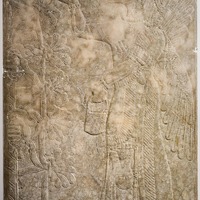
Part of Apkallu with eagle head from the Palace of Ashurnasirpal II