
Cosmological Models of Tycho Brahe, Andrea Argoli, and Copernicus in the Ottoman Context
- Title
- Cosmological Models of Tycho Brahe, Andrea Argoli, and Copernicus in the Ottoman Context
- Date Created
- 17th Century
- Creator
- Tezkireci Köse İbrahim
- Identifier
- MS 403, fol. 23a
- Original Location
- Unknown
- Current Location
- Kandilli Observatory of Boğaziçi University in Istanbul
- Description
-
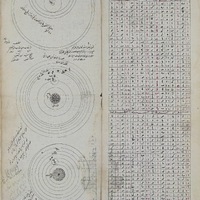
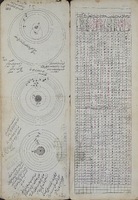
This image comes from a manuscript copy preserved today at the Kandilli Observatory of Boğaziçi University in Istanbul (MS 403, fol. 23a). This copy is considered the first in the Ottoman context to introduce the Copernican cosmological model. It is based on an Ottoman Turkish translation of Noël Durret’s Nouvelle théorie des planètes, first translated into Arabic and then into Turkish between 1660 and 1664 under the title Sajanjal al-Aflāk fī Ghāyat al-Idrāk (The Mirror of the Orbs with the Utmost Understanding). The translation is attributed to Tezkireci Köse İbrahim, an Ottoman bureaucrat and tax collector.
The manuscript contains explanations of the motions of the Sun and Moon, along with astronomical tables and marginal notes. Its diagrams present different cosmological models, including those of Tycho Brahe, Andrea Argoli, and Nicolaus Copernicus. Although the work is based on Durret, the diagram itself has been shown to derive from Argoli’s Ephemerides. In the Ottoman context, the translation is often noted as one of the earliest Ottoman works to present the Copernican system. However, it is not primarily concerned with theoretical debates about the structure of the cosmos. Instead, it was closely connected to practical needs, especially calendar making and fiscal administration, such as improving the accuracy of tax collection. Its preparation coincided with a period marked by financial challenges and reform initiatives in the Ottoman Empire.
As an object, this manuscript illustrates how knowledge moved across languages and regions in the seventeenth century, from France to the Ottoman scholarly and bureaucratic settings. Its preservation today in a historic observatory further reflects the importance of the work for the reception of modern astronomy in the Ottoman Empire. More broadly, the Kandilli collection, with its strong focus on mathematical and astronomical manuscripts in Arabic, Persian, and Turkish, provides an important window into the history of science in Islamic and Ottoman contexts.
---
Further Reading
Ageron, Pierre. “Note sur le dessin du système de Copernic dans le manuscrit Kandilli 403,” Studies in Ottoman Science 20, no. 2 (2019): 115-26.
İhsanoğlu, Ekmeleddin. “Introduction of Western Science to the Ottoman World: A Case Study of Modern Astronomy (1660–1860)”. In Transfer of Modern Science and Technology to the Muslim World: Proceedings of the International Symposium on Modern Science and the Muslim World, edited by Ekmeleddin İhsanoğlu, 67-120. Istanbul: IRCICA, 1992.
Kaçar, Mustafa. “Tezkireci Köse Ibrāhīm.” In The Biographical Encyclopedia of Astronomers, edited by Thomas Hockey et al., 1129. New York: Springer, 2007.
Küçük, Harun. Science without Leisure: Practical Naturalism in Istanbul, 1660-1732 (Pittsburgh: University of Pittsburgh Press, 2020), 108-42. - Credit
- Kandilli Collection, MS 403, Boğaziçi University's Kandilli Observatory and Earthquake Research Institute
- Contributor
- Dr. Hasan Umut, Assistant Professor, Boğaziçi University History Department, Istanbul, Türkiye
- Site pages
- Map
Part of Cosmological Models of Tycho Brahe, Andrea Argoli, and Copernicus in the Ottoman Context