
Glass bottle containing iodine
- Title
- Glass bottle containing iodine
- Date Created
- 1986
- Creator
- Unknown
- Identifier
- 2018.0180.001
- Original Location
- Poland
- Current Location
- Ingenium - Canada's Museums of Science and Innovation, Ottawa, Canada
- Description
-
Things speak. The circulation of knowledge may pertain to artifacts as well as local, everyday experience that reveals global consequences. A bottle of Lugol’s iodine distributed as public medication during the nuclear fallout in Poland from the Chernobyl Power Plant is one such example.
The commonplace qualities of a bottle of iodine are generally unremarkable. This bottle, however, still contains the iodine that was intended as public medication against thyroid cancer during the nuclear fallout from Chernobyl. When the bottle was given to me in 1988, it came with a story.
“Without things, we would stop talking. We would become as mute as things are alleged to be. If things are “speechless”, perhaps it is because they are drowned out by all the talk about them. … Talkative things instantiate novel, previously unthinkable combinations. Their thingness lends vivacity and reality to new constellations of experience that break the old molds" (Lorraine Daston, Things That Talk, 2004, pgs. 9, 24).
On May 2, 1986, my partner Barbara Lounder and I arrived in Amsterdam. It was the weekend of the Queen's birthday celebration and one week after the Chernobyl nuclear disaster. During May we traveled to Frankfurt, West Berlin and the Rühr district in Germany.
In September 1988, I traveled to Lublin, Poland to participate in an exhibition of Canadian artists. My partner Barbara and I had created an artwork that was a response to the time we spent in West Berlin during the Chernobyl disaster. I had a discussion with Malgorzata Sady, one of the Polish curators about the effects of the disaster in Poland. Malgorzata described the anger and fear surrounding the nuclear crisis and showed me a small bottle of iodine that had been distributed by the Polish government as a public health measure. The Lugol’s iodine would avert the thyroid from absorbing the radioactive iodine-131 released by the explosion, potentially reducing the risk of cancer. She highlighted the fact that, in addition to misinformation disseminated by State media, the medication had been distributed too late to be effective. When I asked if she had taken the medicine, she replied, “why bother”. These were the waning days of the Cold War in Poland. At the end of our discussion Malgorzata offered me her bottle of iodine. It was a strange gift from an inconceivable moment in history.
In the Fall of 2010, I was invited to be an artist in residence at the Canada Science and Technology Museum in Ottawa. During the residency, I had a conversation with Anna Adamek (Director of the Curatorial Division) regarding her plans for the exhibition “Energy: Power to Choose” that would open in 2011. In response to her plans for the section on nuclear energy and Chernobyl, I mentioned that I had an unusual artifact, the bottle of Lugol’s iodine distributed in Poland during the nuclear fallout. Based on that conversation, the bottle of iodine and several photographs that I made of protests in West Berlin were loaned to the museum for the exhibition. When the exhibition was over in 2014, I re-gifted the bottle of iodine to the museum collection. Currently, it is the only artifact that appears when you search “Chernobyl” in the collection’s data base at CSTM.
My anomalous journey with this artifact continues to reveal my place in the world through everyday things, hyper-objects, and the abundant threats to our atmosphere that endanger the rights of human and non-human entities to breath and exist. - Credit
-
Copyright Ingenium / CC BY-NC-ND (Attribution-NonCommercial 4.0 International (CC BY-NC 4.0)
Ingenium, 2018.0180.001
Permalink: https://files.ingeniumcanada.org/items/coll/295/889/2018-0180-001-aa-cs.jpeg
- Contributor
- Robert Bean, Professor Emeritus, NSCAD University
- Item sets
- The Things They Carried Exhibit
- Site pages
- Map
- Media
-
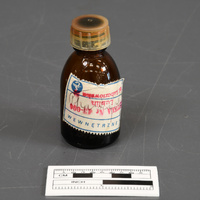 Bottle of iodine
 -
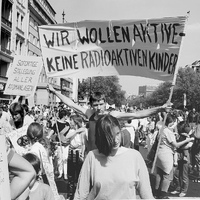 Anti-nuclear protest, West Berlin. May 17, 1986.
 -
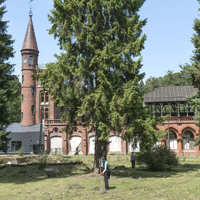 Brehmer Tuberculosis Sanatorium (1854) Contexts Festival, Sokołowsko, Poland, July 2017.
 -
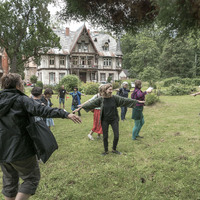 “Quarantine: quaranta giorni”, Contexts Festival, Sokołowsko, Poland, July 2017 [two years prior to the COVID pandemic]. Situated Walk and Installation by Robert Bean + Barbara Lounder.
 -
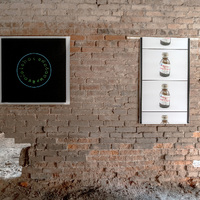 “Iodine” installed in the Brehmer Sanatorium, Contexts Festival, Sokołowsko, Poland, July 2017. Situated Walk and Installation by Robert Bean + Barbara Lounder.
 -
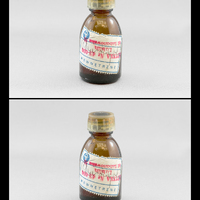 “Iodine” (detail), Contexts Festival, Sokołowsko, Poland, July 2017. Situated Walk and Installation by Robert Bean + Barbara Lounder.
Part of Glass bottle containing iodine